Showing posts with label Space. Show all posts

Wednesday, April 22, 2009

Mars, Microbes, Rovers & Kepler

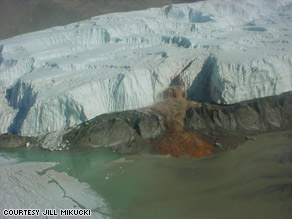
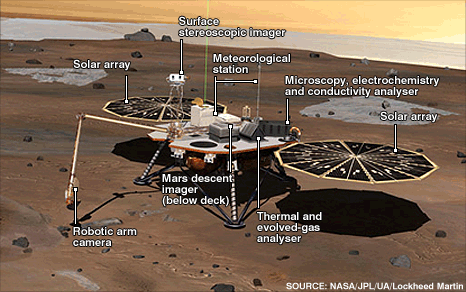
Science is enjoying a renaissance capturing a broken 5 year old Spirit valiantly struggling in the Martian 2009 Spring, million and half year aged microorganisms  making Antarctica's Taylor Glacier look like its been socked in the nose, staining the ice and snow red.   Mars is full of iron deposits and so is Antarctica, but no correlations can be drawn just yet.  But oh the possibilities.  In Antarctica, seawater teeming with life became sequestered as sea levels rose and majestic glaciers formed and gained mass.  Now those same ice mountains are melting and behold, microbes unleashed for the first time from their salt laden frozen blocks.  Yet, the Phoenix Lander Mission to a lopsided Mars found mineral deposits in the soil after baking the samples in the space-age TEGA ovens, leading to the estimation that a veggie such as asparagus could likely grow in the region. 
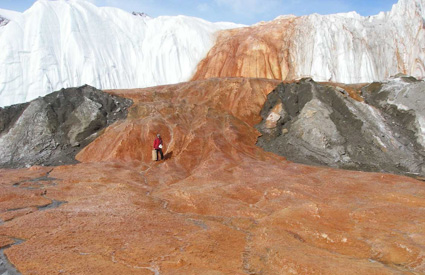
No oxygen in the microbial finds, but life was proceeding apace with one species continuing to split cells and multiply.  Blood Falls, an evocative name that describes the glacier nosebleed is annually a scene of wonder and speculation among the scientific community.  Where else in space is this replicable and mars is one f the first places everyone is considering in the realm of the possible for a bacterial colony like this to exist. (Image Benjamin Urmston)
Mikucki refers to the subglacial pond as "a unique sort of time capsule from a period on Earth's history," but it also has lessons for scientists studying Mars, an entire planet that is in many ways a time capsule too. Mars, like Antarctica, was once warm and wet, but the slow loss of its atmosphere also meant the loss of much of its moisture and surface heat. Still, the place was warm and wet long enough for life to have taken hold — life that would have then had to retreat into underground water deposits and make the same kind of hurry-up adaptation Mikucki's microbes did. Similar adaptive metabolism could be in evidence on the Jovian moon Europa, where a layer of surface ice may cover a globe-girdling ocean.
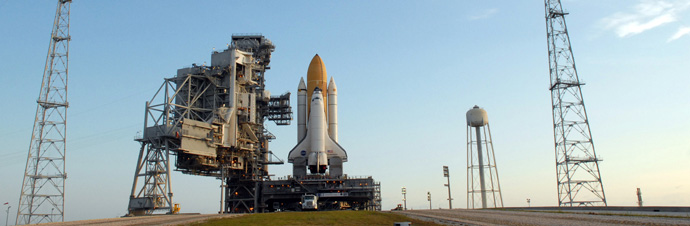
Now Kepler, the planet hunter, has reached its field of study with all the areas gridded for Scientists.  The first pictures came the second week in April.  Kepler's mission is to spot other planets that have possibilities similar to the planet Earth.  Meanwhile Hubble is still sending back the most amazing pictures of stars in varying stages that are just poetic to see.  Hubble remains without peer and this is the final mission to service the telescope.  As STS 125 gears up on the launch pad, the unusual scene of Shuttles Atlantis & Endeavor being prepped side by side is apparent in this image from NASA.

Endeavor

The Rover twins are in various stages of health.  A Martian windstorm cleaned off Opportunity's solar panels leaving the rover to break new ground.  Spirit the wheel-challenged Rover, that discovered the silica, is temperamental when responding to NASA.  Independently, Spirit rebooted its system.  There is no template to say how many times this can occur.  Meanwhile, there's news an earth-sized exoplanet has been spotted in a HZ or Habital Zone in the Gliese system less than 22 light years away.  The true test if when we can ascertain there is liquid water.  We need more powerful telescopes to see that what is in our Milky Way's obscure places.   Science is being treated with more deference now that facts are overwhelming all the naysayers.
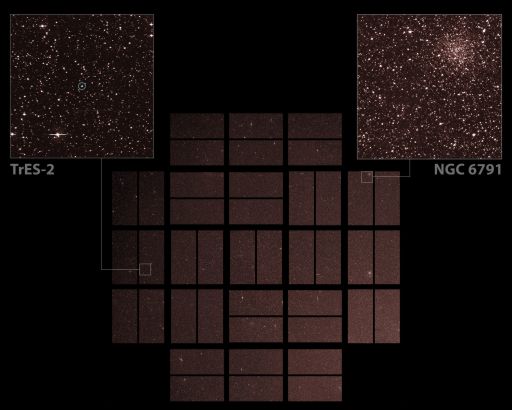
(From Kepler courtesy NASA - First Light - The field of study - millions of stars)
Today is Earth day, and those fortunate few who have ridden into space say there is nothing like the view of our shared planet from space.  preserving our existing globe while exploring all that is within out scientific reach in space is the best of all worlds.  Many Thanks to my former senator, the late Gaylord Nelson, for making Earth Day possible and environmental activism probable!
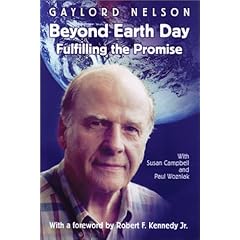
Beyond Earth Day:  Fulfilling the Promise with Gaylord Nelson, Susan M. Campbell and Paul Wozniak.


Tuesday, March 10, 2009

Teachers In Space

Wednesday is launch day, actually night 6:20 pm PDT, for space shuttle Discovery to photogenically blast into the heavens to park at the International Space Station (ISS) with parts for recycling pee into the clean drinkable water machine, a $300 million USD 31,000 pound truss segment to support the additions to the ISS, more items for the solar arrays and two teachers. Discovery's crew has to vacate and finish their spacewalking and scientific chores by March 26 because the Russians booked the penthouse suite with the Soyuz capsule making a grand entrance and bringing a new ISS crew. One space visiting team at a time and there is no place to fill up with rocket fuel in space yet.

More solar equipment means more power to tun the increasingly sophisticated apparatus at the ISS. Recycling urine is important because May heralds doubling the size of the crew from 3 to 6. The US space shuttle program is due to end in 2010. Up to this point there have been a multitude of spectacular successes and tragic failures accompanied by loss of life. Honoring the pioneer of teacher in space, NASA reopened its program for teachers after the 2003 mission failure and two teachers are now fully fledged astronauts hurtling out in maximum G's on STS-119. Those two teachers, Joe Acaba and Richard Arnold, are actually each going to don a spacesuit and go out for a spacewalk. (Discovery photos courtesy Reuters)

Richard Arnold started by teaching college preparatory courses in Morocco, then moved on to schools in Saudi Arabia, Indonesia and Romania. Joe Acaba, an ex-Marine, found his calling in the classroom after a tour in the Dominican Republic with the Peace Corps.

“As an educator,” Arnold said, “you presumably believe in the notion that education can take you anywhere. Here we are. We’re knocking on the door. We’re about to go to space.”

Selected for the space agency’s educator-astronaut initiative, Acaba, 45, began training in 2004 with nine others. 41, and ArnoldNow, NASA has put them on the same shuttle flight.

“We were both surprised when we were assigned,” Arnold said. “I was really happy to be flying with a classmate, and I was really happy it was Joe.”
Watching such a vivid night launch via NASA webcast is going to be fun. The weather forecast looks great barring any equipment failures like the one that scuttled the February 12th launch. Right now the crew aboard the ISS is doing some routine maintenace and spacewalking chores before Discovery arrives on Friday. The space station is nearing completion with all of the cool gadgets like Canada's robotic Mr. Dexter, Japan's Kibo Room (and a Japanese astronaut is on board this flight) and the view of Earth from the ISS space "porch" is said to be unparralelled. What a great teachable moment in science.

Just because I love his books and his whole attitude about science, I will tout Neil deGrasse Tyson's latest wonderful snarkfest in book form, The Pluto Files. It would be the perfect book to take into space when you have some downtime at the International Space Station.


Oh well, the space shuttle seems like its not going anywhere today due to a gas leak. (3/10)


Saturday, December 20, 2008

NASA Finds Carbonate, But Not Funds

NASA found water on Mars with the MIA carbonate minerals giving way to being able to land somebody there for the rest of their lives to colonize the planet in the future. NASA has some skin in the game as a President Obama is going to decide the mission and the money to go into the programs that shape the space race. Right now the president-elect is heavily focused on earthbound scientists who are bit more aghast at Global Warming and the damage incurred by the Neanderthals that were in charge that denied it all. Meanwhile, the head of NASA and his seven degrees got into a snotty spat with the ex-NASA scientist, current head geek of the Obama transition team about the Constellation project and its funding because its way over budget with an end schedule like the number π. Endeavour went up, came down, knowing in about a year nobody from the US is going into space without thumbing a wild ride on Mr. Putin's Russian rockets.

Now its the 3,600,000,000 year old acidic belief system on trial. The Mars Reconnaissance Orbiter by virtue of the Compact Reconnaissance Imaging Spectrometer for Mars (CRISM) beamed back evidence that some spots like the crater Isidis are less acidic and life gain a green toehold. The images are under review as the carbonates would have dissolved or dissapated long ago and not shown up for their Orbiter DeMille-like closeups. What it really means is a tiny step closer to rationalizing a fantastically expensive but scientifically prolific trip to Mars. Manned or unmanned just makes the stakes that much higher because they need a really powerful rocket... Out of the endless loop, comes proof that the mineral is there giving hope that missions even past Mars are possible.
"Carbonate, like the baking soda in your refrigerator, dissolves quickly when exposed to acid," said study leader and Brown University professor Bethany Ehlmann yesterday at an American Geophysical Union meeting in San Francisco.
"So the fact that … carbonate is still present means that the waters flowing through [Nili Fossae] must not have been acid" and could therefore have been conducive to life.

Bacteria and microbes on a meteorite that plopped down to Earth help the hypothesis that life could exist on the red planet. Right now its just a theory that is gaining a foothold as more discoveries are made. The Phoenix Lander and the Energizer twin Mars Rovers have paid for themselves a hundred times over with their discoveries. With each new discovery and scoops full of analyzed dirt more questions arise out of the oxidized red dust. But NASA's next rover that could settle the life (bacteria/microbe) on Mars question, the Mars Science Laboratory rover, is experiencing a two year delay from 2009 to 2011 due to design challenges. That's a big money fix in the works. Spirit and opportunity have taken full effect of the solar panels to beam back photographic evidence. (Photo Opportunity on Mars 2004 NASA)

Now where ever will the financing come from in a totally broke USA to fund the next Rover, Lander, Pathfinder steps? I am sure President Obama will get a group of science money people to find money on Earth to support life on Mars. An international coalition, oh yeah, the International Space -Hotel- Station needs some new bunk beds too. Russia, we'd like to book room for a party of six... Obama is going to find a spare billion somewhere in the name of science and carbonates on Mars.

Passion for Mars: Intrepid Explorers of the Red Planet enlists the imaginations of famous planet watchers to envision what it would be like or take to live there. NASA has finite resources and Mars aficionados are planning to keep the red planet at the top of the list someway, somehow. My guess, some sort of gravitational knowledge pull with a black hole that sucks in the naysayers. Andrew Chaikin writes a biography of the current and future of the red planet that will fire the imagination rockets into our own Habitable Zone in space.

Wednesday, October 8, 2008

Mars Lander to Freeze to Death as it Snows


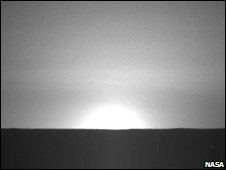
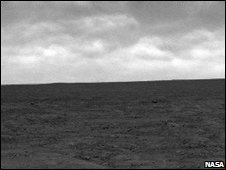
Winter begins its rampage across the red planet. Martian weather is all the nerdy rage as an actual snow storm produced flakes. The Phoenix Lander has no place to hide as the thermometer races downward. Solar power provides its juice, but no blanket, as the original plan had been for a 90 day summer job. Phoenix has had its death sentence commuted twice, from August to September and then through the Martian holiday season. The challenge for Phoenix is surviving long enough to make it through December as the region it is working in is the north polar area. Closer to Mars equator, the almost 5 year old death defying Rover twins, Spirit & Opportunity, are able to power down, hibernate and soak up solar energy for the winter season while the Mars satellite babysitter observes from its orbit. Anything extra was Martian space gravy for the Phoenix scientists studying the planet for signs of life, water and digging for ice. Good thing that the next iteration of a lander, MSL, is going to be the size of an Earth endangered Hummer.
"We're at the mercy of Mars," said Phoenix project manager Barry Goldstein, of NASA's Jet Propulsion Laboratory in Pasadena, Calif.
As winter descends on the Martian arctic, two important things will happen. The sun will sink below the horizon, and "it's going to get cold." said Phoenix meteorological team member Peter Taylor of York University in Toronto, Canada.
Of course, Mars is never warm by Earth standards (it is further from the sun and lacks our planet's thick, heat-trapping atmosphere), but summer above the Martian arctic circle is downright balmy compared to the winter.
It is not even the thick of winter and nighttime temps are -112° F or -80° C. Now that's just freeze your steel parts off cold. But part of the weather phenomenon that has amazed Mars' storm chasers are falling snowflakes, Frosty the Lander style. The Mars Maginot line of death is at 1000 Watt-hours - the minimum amount of solar caffeine needed for the Phoenix to wake up from a frozen nights slumber. There is a race on now between the scientists to get all of their experiments done because no one wants to be the person that has to say it was just this close to proving the first Martian organism that could survive in these conditions before Phoenix freezes solid. No one expects a Lazarus like reemergence come the spring thaw as it will be three months since the sun dropped below the horizon before it peaks over the area again. Lander scientists think Phoenix and Ted Williams styled cryogenic awakening are mathematical improbabilities.

Meanwhile, let it snow, let it snow let it snow. A Martian snowflake caught by a nifty pulsing laser before it ever hit the ground.. Ready sources of red planet water from frost, clouds or in the dirt are important as missions landing people on the red planet need it for survival. Already missions are being drawn up to land astronauts in habitats on the moon in preparation of preparing for a Mars manned spaceflight.
Scientists don’t know yet exactly what Martian snow looks like to the human eye.

"We’ve been trying to capture some snow (on camera) but so far have been unsuccessful," Mr. Dickinson said. "We’ll keep trying. But if we don’t get lucky, that might be something we’ll have to do on the next mission."

The presence of snow means humans might be able to live on the freezing planet.

Of course there is the irony of Canadians finding the snow first...

NASA has laid the ground work for years for a mission. Here is a book they put togther to outline some of the details and challenges for a manned spaceflight mission and what to do one getting off the years long flight pretty much knowing there is no return ticket. The book is The Case for Mars Concept Development for a Mars Research Station: Concept Development for a Mars Research Station - the title pretty much sums up how NASA killed firing up the public imagination on the topic.

Friday, August 22, 2008

Coming Soon: Mystery of the Black Hole


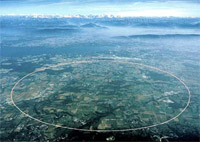
Dire predictions, nails bitten to the quick and nerd joy at the prospect of finding and proving some of physics deepest secrets will play out in on computers in a science red carpet moment. In a monster opening box office, September 10th looms large for Doomsday prognosticators, science watchers and CERN citizens will watch with bated breath as the curtain pulls back and a shaky finger pushes the go live button on the world's largest particle physics lab. The Large Hadron Collider (LHC) fires up to smash atoms faster and harder in a cool horror flick kind of way while the search for making Earthly black holes climbs to a new level. There are some nervous nellies freaking out that the world will be instantly sucked into the vortex of a man-made black hole beyond the event horizon to save ourselves from becoming a tossed space particle salad. Somebody wanted to hold the nuts...
Battle of the Colliders
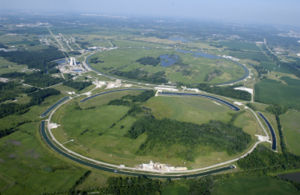
Much larger CERN versus the older Femilab - may the best atom slayer win....
But near Chicago, Illinois, the US Department of Energy's Fermilab is saying, look at us, we have the capacity with Tevatron's 170 giga electron-volts to find the God Particle too, if it exists, except, the European Organization for Nuclear Research or CERN is is the almost $4 billion USD Godzilla of the particle collider realm. Sequels already. It will be a notable international event about who and where the origins of life are found as atom guts are examined ad nauseum. Dark Matter will star as studies and dissertations do mortal combat to prove the existence of other dimensions tearing asunder current belief systems. The Higgs boson has captivated one man for nearly forty years and is one of the remaining theories that the atomic colliders are focused upon. CERN's LHC is brand new.
“We don’t know what we’ll find,” said Abra­ham Sei­den, di­rec­tor of the San­ta Cruz In­sti­tute for Par­t­i­cle Phys­ics at the Uni­ver­s­ity of Cal­i­for­nia, San­ta Cruz, a U.S. par­ti­ci­pant in the proj­ect. About half the U.S. ex­pe­ri­men­tal par­t­i­cle-phys­ics com­mun­ity has fo­cused its en­er­gy on the col­lider’s two larg­est par­t­i­cle de­tec­tors, called AT­LAS and CMS, ac­cord­ing to Sei­den.

LHC is huge in eve­ry way—its size, the en­er­gies to which it can ac­cel­er­ate par­t­i­cles, the amount of da­ta it would gener­ate, and the size of the in­terna­t­ional col­la­bora­t­ion in­volved in it. The pow­er­ful beams of par­ti­cles are to cir­cu­late around the 27-km (16.8-mile) un­der­ground tube at CERN, the Eu­ropean par­t­i­cle phys­ics lab based in Ge­ne­va. Af­ter some test­ing, the beams are to cross paths in­side the de­tec­tors to make the first col­li­sions.


Sci­en­tists say the de­bris from those crash­es—show­ers of sub­a­tom­ic par­t­i­cles—will rev­o­lu­tion­ize our un­der­stand­ing of na­ture. A key hoped-for mile­stone is disco­very of the Higgs bos­on, a hy­po­thet­i­cal
par­t­i­cle that would fill a gap in the “s­tan­dard mod­el” of par­t­i­cle phys­ics by en­dow­ing fun­da­men­tal par­t­i­cles with mass. This should oc­cur by 2010, Sei­den said, if the Higgs ex­ists at all; na­ture may have found an­oth­er way to cre­ate mass. “I’m ac­tu­ally hop­ing we find some­thing un­ex­pect­ed,” he said.

Black holes are delicious Hollywood diva stories waiting for their closeup. The flying spaghetti monster is what nonbelievers called believer's God or Higher Power in the Universe and science is seeing what makes the noodles flop about in space. Touched by his noodly appendage What happens when one or an entire star like the sun is sucked into the stuff of cosmos conflict - only black holes are theorized at the creation/destruction of particle levels.

Dr. Hawkings, the as-yet non Nobel winning brilliant physicist has some strong feelings on the subject. In an interesting newly released book from Stanford professor Leonard Susskind, The Black Hole War: My Battle with Stephen Hawking to Make the World safe for Quantum Mechanics details the intricacies of the arguments between the generalists and the string theory practitioners over the years culminating in verbal fisticuffs over what happens inside a black hole. Buy & Read the book first, the movies always screw it up.

Happiest of Birthday's CJ - the world of science will make many great things probable, but your Faith shall make all things possible!

Tuesday, July 22, 2008

Plutoids: Dwarf Challenged Planets

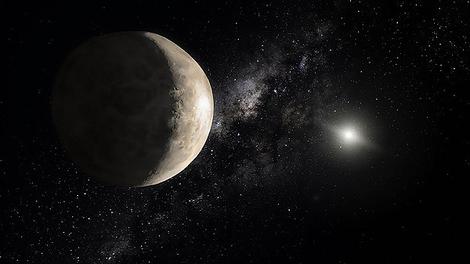
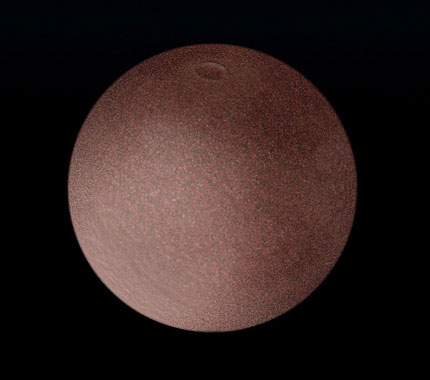
There are only 8 planets in our Solar System. Pluto, the former planet, unceremoniously dumped by astronomers from the International Astronomical Union (IAU) as worthy, is now out there spinning spherically in the asteroid belt. Its public humiliation led to a new word: Plutoid. Not quite a planet, not quite an asteroid, an underdeveloped planetary tweener. In 2005, scientists began naming like minded spherical satellites, Dwarf Planets. Just last month, dwarf planets evolved as a classification with an announcement of the sub-class, Plutoid. The plutoid has to be really bright to get on the list. July 11, 2008, the IAU conferred plutoid status on Makemake due to its surpassing the absolute magnitude threshold.

Now space scientists says the pockmarked Putoids have friends. They are a team of three, almost a 1/3 of the number of "real" planets. From out in the Kuiper Belt, MakeMake, the latest discovery looks like a girl's mauve bowling ball with only one finger hole. It's named after a Polynesian Fertility being, so maybe more are on the way. Being scientists there is a distinct difference between being a dwarf planet and a Plutoid. There is a PhD in lost in space to be discovered in there somewhere.

The smallest of the plutoids, Makemake was discovered in March 2005 by a team of scientists led by Michael Brown, from the California
Institute of Technology, and it was first named 2005 FY9 (unofficially known as
Easterbunny). The name Makemake was chosen later on by Michael Brown himself,
after the god of fertility from the Island of Rapa Nui (or the Easter Island).

We consider the naming of objects in the Solar System carefully. Makemake's surface is covered with large amounts of almost pure methane ice, which is scientifically fascinating, but really not easily relatable to terrestrial mythology,” Brown explained. However, the Island Rapa Nui came to mind, and a brief search through mythology brought Makemake to light. Image credit: Ann Feild (Space Telescope Science Institute)

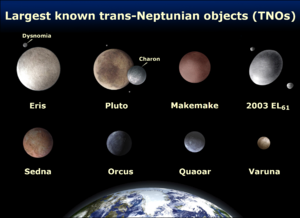
The last full planet stop in this solar system is Neptune. That Easter Island came to ruin is somewhat Ironic. Far off the coast of Peru and Chile, Rapa Nui or as the European called it Easter Island, is now a UNESCO World Heritage Site. According to lore, MakeMake created humankind and was the chief god for the birders - before the island was denuded of trees resembling a plutoid. Don't think the Plutoids or Dwarf planets have a shot at the earthly UN designation. However it dows get to be a proud TNO or trans-Netunian Object that is brighter than bretheren like .

Take Pity on me and Pluto. Purchase the book, When is a Planet Not A Planet: The Story of Pluto. Elaine Scott explains the dwarf planet nomenclature for the pint sized among us. Those large will find the full story on Pluto and the solar system quite interesting.

Wednesday, July 16, 2008

Russian Scientists in Space & on Thin Ice

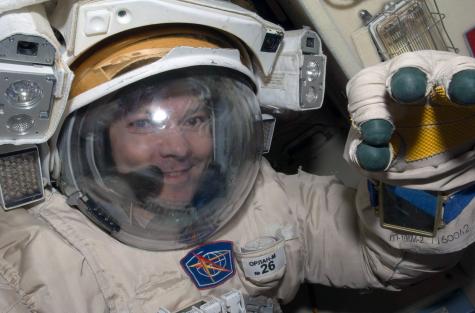
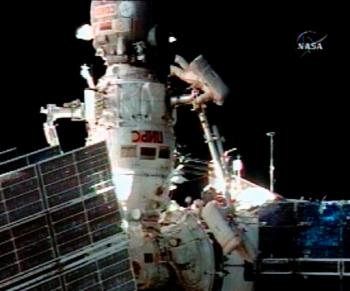
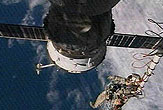
Russian cosmonauts, tethered and floating above the ISS in the final frontier have taken two spacewalks in the past week. Sergei Volkov the commander and flight engineer, Oleg Kononenko, were brave space virgins on walking outside their 17,000 mph Earth orbiting metallic space condo. July 1oth was a high risk affair, yet necessary walk on the wild side due to an explosive space bolt that was the suspected culprit causing returning Earthbound Russian Federal Space Agency's Soyuz capsules to land beyond the intended targets. The last two times those capsules carted humans and put real fear into them. On a scheduled the rockets park or dock at the International Space Station ferrying up necessities, mail and tools. Fresh water is exceedingly heavy and beginning the installation of a water purification system that takes essentially urine and cleanses and purifying water will be of great import for the ISS's continued expansion.

Dressed in their Sunday best Orlan space suits the preparation begins for installing the new lab module due to arrive in 2009. A docking station and removal of a prior biological experiment that collected results of solar radiation with Zero gravity on microbes and other small organisms are on tap for the cosmonauts second fling outside the space lock. There is a lot riding on the Russians in space as they install one of their own experiment, Vsplesk, expected to yield data on the seismic effects of high energy particles. Sort of like a micro mini space collider in space.

Many forget that the first person in space was Russian, Yuri Gargarin in 1961. In 1963, the first woman blasted into space was Valentina Tereshkova. Those space firsts, accredited to the USSR, fanned the flames of the space race to command the starry heavens and load them up with Russian, Chinese, American, Nigerian, Japanese - among others - space junk, science experiments and super secret spy satellites as well. Now, in theory, its all about international space cooperation and the need to rely on other nations to build in the capacity to do intricate space walks and set their own experiments to add to the body of science.
Both spacewalks have required the cosmonauts to exit from
the Pirs
docking compartment, which also represents the only passage between the space station and the Soyuz spacecraft that serves as an emergency lifeboat. U.S. astronaut Greg Chamitoff will once again spend the entire spacewalk sitting inside of the Soyuz, so that he does not get cut off in the unlikely event of a crisis.

Kononenko will install the docking target by riding the long arm of the Strela hand-powered crane to the Zvezda module. Volkov will operate the hand-powered crane and move his fellow astronaut to the target location.

Next, the cosmonauts will use a spacewalker's ladder and move to a different part of Zvezda to inspect some bolt holes. The holes will serve as the location for a future antenna adapter that will serve the Kurs automated docking system.

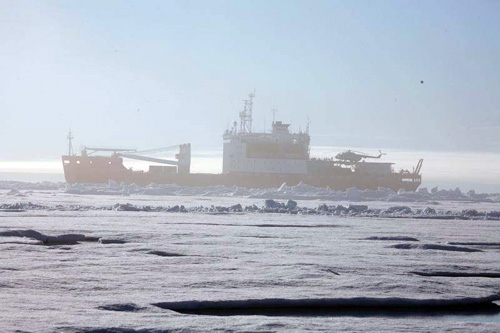
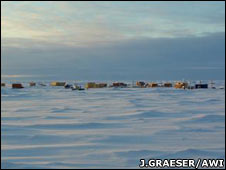
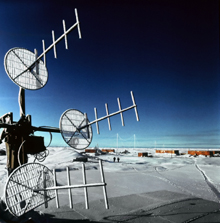
Meanwhile, the advent of global warming put other Russian scientists at risk of sinking beneath the frigid waters as their lab sits atop unstable melting polar ice. Those land bound scientists put out an Ice May Day call and await an early rescue as sloshing and mush and breakaway ice is occurring at an accelerated pace. Global warming is causing the early evacuation of North Pole-35 station where two mutts live in huts with 21 researchers and scientists scurrying to pack up specimens and other tools. To the rescue is a nuclear powered ice breaking ship, Artika, which will cut a path for another ship, Mikhail Somov that will take them back to the critical Russian port city of Murmansk. Polar politics is en vogue and heating up this season along with the Earth.

Russians were studying the flora and fauna that survive and thrive in those geological conditions while making a point to the US primarily about who owns what is still contentious. Unfortunately they started with 3 square miles of ice to explore, build a winterized camp with room for the dogs and their acreage has melted down to a wee bit under 3/4 of a mile.
North Pole-35 is the 35th time Russian scientists have floated across the Arctic since 1937. On previous missions, they’ve helped define Russia's claims to Arctic territory, including the rich oil deposits believed to lie beneath the northernmost ocean. The current expedition started in September 2007, and most last at least a year.

The early rescue is yet another sign that the Arctic sea ice is rapidly disappearing. It worries climate scientists because the impacts of the
North Pole melting are unknown. They could include changes in the amount of rainfall and snow across the northern hemisphere. Still, it is of a piece with U.S. ice experts’ predictions that the Arctic could be ice-free as early as September of this year— a situation unknown in recorded human history—thanks to an early start to the melting season and a record retreat last year that left weaker ice in its wake. Russian scientists’ ability to go with the floe in future may be in doubt.
In space and on ice, Russian scientists and explores seem to be having a thrilling time in the name of science.


After the stunning world debut of Sputnik, author Brian Harvey looks at historical and current trends in the Russian space program. His book with a long winded titled, but chock full of arresting information is The Rebirth of the Russian Space Program: 50 Years After Sputnik, New Frontiers is a pretty expensive paperback worth the time and effort.


Friday, July 11, 2008

Moon Water Found in Moon Rocks

Itsy bitsy beads of moon dew were found by space water hunters in crevices and cracks of moon rocks collected almost forty years ago during Apollo missions. Those rocks reside in museums, like the National Museum of Natural History right smack dab in middle of the DC mall with nobody knowing they still held microscopic droplets of a secret. Lunar legend had the waxing and waning moon made of curdled milk, otherwise known as cheese as cows jumped over a barren landscape. Now the rock race is on to find and secure the wellspring or origin of moon water that makes the Moon Eden more possible than the previously believed desolate lunar desert plains. The moon's gravity pulls and pushes the tides, with a small assist from the sun, while Earthlings seek water to remake Man on the Moon as an inhabitant rather than a mere space tourist. Water makes living on the moon more possible for researchers and scientists.
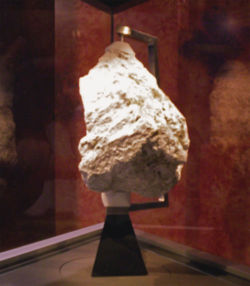
In a study published today in Nature, researchers led by Brown University geologist Alberto Saal found evidence of water molecules in pebbles retrieved by NASA's Apollo missions.

But a high-powered imaging technique known as secondary ion mass spectrometry revealed a wealth of so-called volatile compounds, among them fluorine, chlorine, sulfur, carbon dioxide -- and water.

Critically, telltale hydrogen molecules were concentrated at the center of samples rather than their surfaces, assuring Saal's team that water was present in an infant moon rather than added by recent bombardment.

The Outer Space Treaty treats the moon like international waters on Earth and expressly forbids nuclear weapons being deposited on the Moon or any other nefarious weapons of mass destruction. The Moon Treaty goes as wallpaper as no nation with the power to get to the moon will affix their signatures let alone ratify a document stating no single nation shall be the proprietor, crusading capitalist or exploiting developer of the Moon's meager resources, such as the misty droplets or any other celestial heavenly body. The international stakes just went up tremendously for China, Nigeria, Russia, America the confederation of the European Space Agency and don't forget Poland plus others, developing space programmes.

Finding the presence of water in rocks brought back to earth throws open the door to moon possibilities even wider. Outpost on the moon anyone?


The Apollo mission in 1969 kicked it all off. The way those missions happened and the meticulous planning is captured in a book every space enthusiast should own, How Apollo Flew to the Moon from W. David Woods, a truly spectacular space nerd author with serious creds.