Showing posts with label France. Show all posts

Sunday, May 3, 2009

Cinco de Mayo, Courtesy of the French


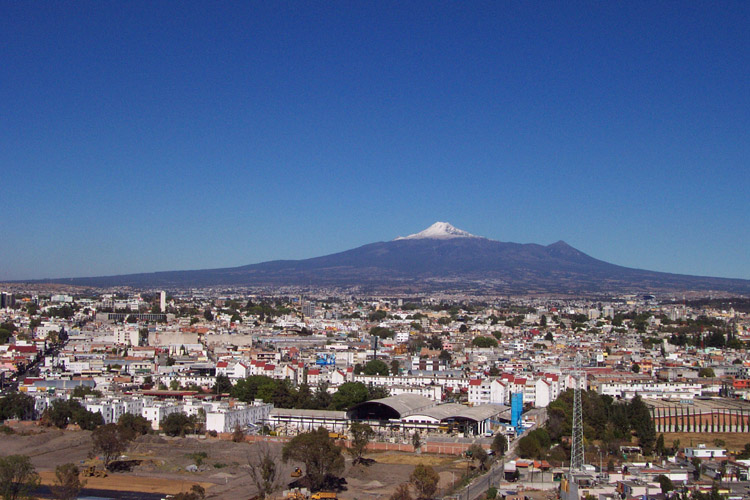
(City of Puebla, Mexico. North view, toward the Malinche Volcano)

East of Mexico City lies the landlocked state of Puebla, now formally named Heróica Puebla de Zaragoza. On May 5, 1862, La Puebla de los Angeles, Town of the Angels, hosted the scene of an arrogant Napoléon III and the Imperial French Army's comeuppance by a poorly supplied yet tenacious Mexican Army. At the time, America was a two nation country dragging the southern part back into reunification one bloody battlefield at a time with no real interest in Mexico's internal strife. Besides, America considered France a friend. The people of Pueblo harbored no such illusions. The whole American friendship thing exited with the idea that an emperor or monarchal rule went against what the young war torn nation had fought against before the French republicans lopped off Marie Antoinette's head. Mexican men & women fought off a better supplied Second Empire army that had a disticnt advantage of twice as much manpower to thwart the colonization of central Mexico. It took six years before France threw in the towel when they went in expecting an early crushing of dissent victory after installing Emperor Napoleon's puppet as a Mexican Emperor, the soon to be executed Archduke Ferdinand Maximillian of Austria by Benito Juarez's order.
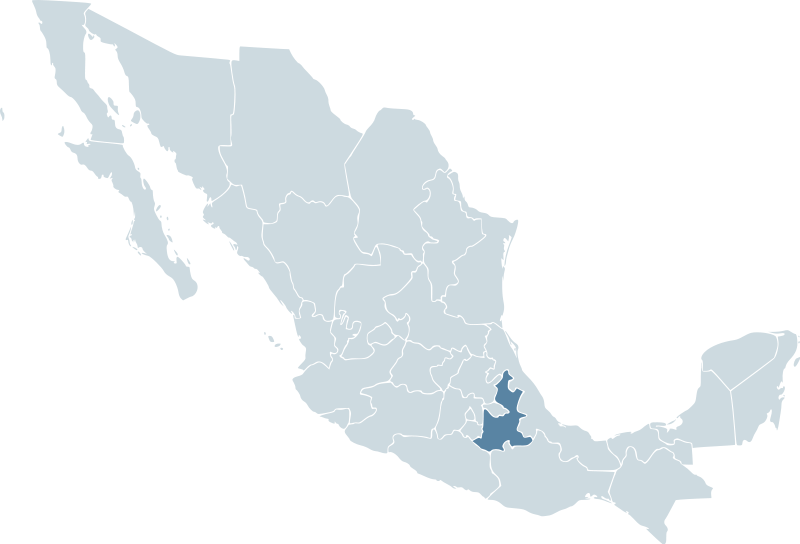


Photo of escaramuza - women in the Mexican Revolution - courtesy Nelvin C. Cepeda/Union Tribune
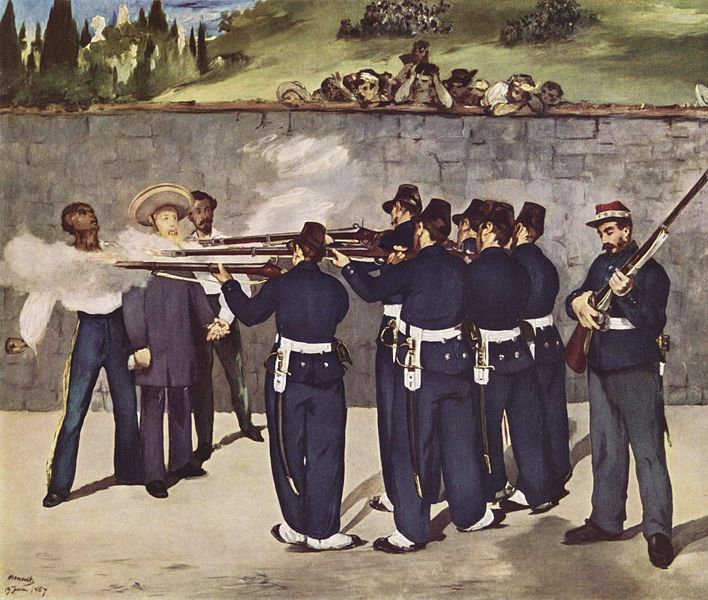
In a turnabout induced by time and immigration, Cinco de Mayo is now very popular in the United States but remains a regional phenomenon in Mexico. Pueblo's battle did not decide the outcome, but what a morale booster that Emperor Napoléon III and the 8,000 French soldiers could be beaten by the few people under the command of General Ignacio Zaragoza Seguín. The Execution of Maximillian I (and only) of Mexico was captured by the renowned Spanish painter, Édouard Manet in a painting of the ame name. In the 21st century, Cinco de Mayo captures the American imagination while giving those of Mexican descent a means to celebrate a part of its rich heritage.
French interventionism, the first time, went under the anglicized rubric of the Pastry War (1838 -1839) goes by the name, Primera Intervención Francesa en México, in Spanish. The word croissant does not imediately conjur up images of Mexico, but entire battles and many nations including the Republic of Texas became charbroiled over a French baker demanding payment for a ruined shop in Mexico. A French blockade ensued with Americans eventually aiding the Europeans resulting in eventually bringing the venerable Santa Anna out of retirement.
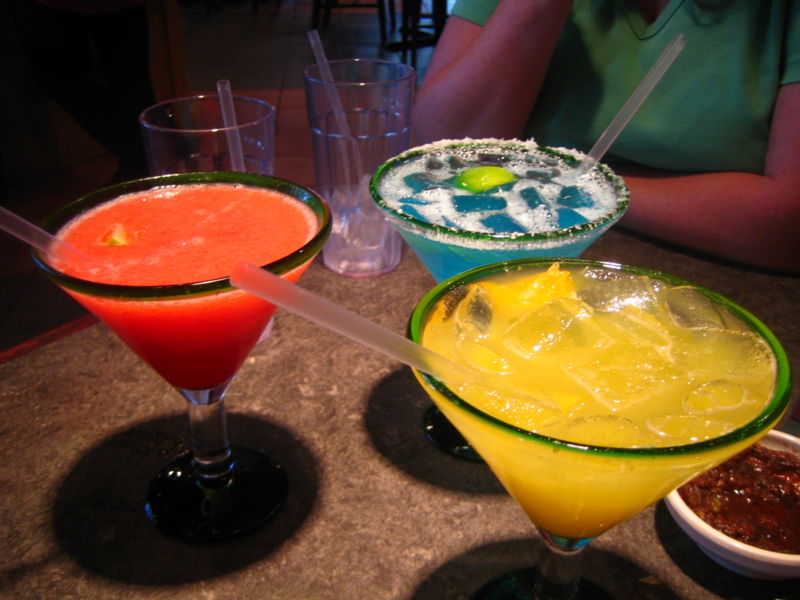
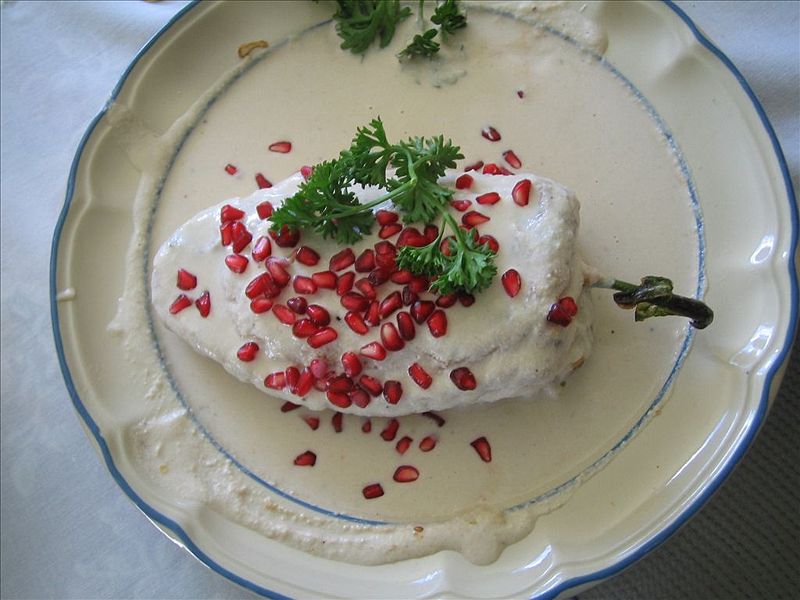
Cinco de Mayo is now also a cause to celebrate Mexican cuisine and drinks. In a spirit of patriotism the Chiles en nogada uses the three colors of the Mexican flag. Food influences allow people to go forward presenting each with treasures from their own culture. The margarita enjoys a variety of flavors, yet for a few of the orange flavored liqueurs a mexico product with a French label Patrón Citrónge, or the imported Cointreau , blue curaçao produces the stunning blue margarita. Yum. Add a little mariachi music and the celebration is ON!


It was setting my teeth on edge that the most prominent authors on Cinco de Mayo were An
glo. So after looking here is a great history for the younder set, Cinco de Mayo:Yesterday and Today, from Maria Christina Urrutia and Rebecca Orozco.


Saturday, March 14, 2009

French Workers Hold CEO Hostage


For eighteen hours, the CEO of Sony's Division in France understood what its like to not be in control of the business and cut off to the outside world. In modern times, most French workers suffered continuous massive unemployment rather than layoffs. The current worldwide pandemic of economic meltdowns is being felt from the tiniest hamlets to the most gilded ivory towers. In France, strikes and shutdowns are the most common civil disobediences showing displeasure with the government and the captains of industry. This is a new twist boss knapping, kidnapping the ultimate bad news bearing boss, that is happening with greater frequency.

CEO, Serge Foucher, floats in from plush corporate Headquarters in Paris to give very bad news of a full plant shutdown in a month, bid them all a fond adieu with expectations to blithely float back out leading his flock of executives, except this time the doors were barred by 311 irate workers, who in a communal Howard Beal moment, were not going to take it anymore. The terms and conditions of their unilateral surrender of their jobs were unacceptable and Foucher and Roland Bents, the head Human Resources genius, were staying during the negotiations on severances no matter what!
"We hope that this time our voices will be heard," unionist Patrick Achaguer told Reuters news agency.

Mr Foucher's visit to the plant on Thursday was to be his last before its closure, the AFP news agency reports.

Workers, unhappy that their pay-off is less generous than for staff at other closed French Sony plants, decided to strike and barricaded the site to stop the company executives from leaving.

Cheap payouts that decrease benefits and without equality to similar circumstances have sparked protests in the United States at an Illinois window factory. Those workers barricaded themselves in for days. The French workers gave them food and drink, but the dapper management brigade had wrinkles in those suits from sleeping on the floor the next morning. No five star accomodations for the heartless. Trucks were used to block the entrances. The real problem began with a public pronouncement to the Sony workforce from some executive theoretical bubble that they would convert to a green facility making solar panels, except then it was deemed impractical and the plan shelved for the Pontonx-sur-L'Adour plant going from job to no job. Oops.
"Local officials persuaded us to release our bosses and continue with supervisednegotiations at a council building.

"This time we hope they listen to our concerns properly."

The move is the latest clash between unions and management in France, which is being hit by a wave of factory closures and big lay-offs because of the global economic downturn.

Workers at a Continental tyre plant in northern France hurled eggs at managers yesterday to protest against the loss of 1,200 jobs with the closure of the factory by the German car parts group.

Insult to injury was the lack of consideration of those who worked past age of 55. The final decision to be made by Sony management is whether to press charges for thier captivity. Hmmm, could get ugly. After 18 hours, the best the CEO gave was they would reconsider their exit packages for the workers. Hmmm, corporate speak for no comment of what I really think until I am safely ensconced back in my Parisian rarefied arrondisment.


Well, there certainly is a choice - buy less of Sony's products, thereby forcing them to reduce staff more or buy more to ensure those with a job keep it. Except nobody is dicussing the matter civilly in these times. To that end, a wonderful book, Crucial Conversations: Tools for Talking About Broken Promises, Violated Expectations and Bad Behavior, from expert Kerry Patterson may perform the right rescues.


Monday, October 27, 2008

Staying Sane Teaching Sticks as Drug War Rages

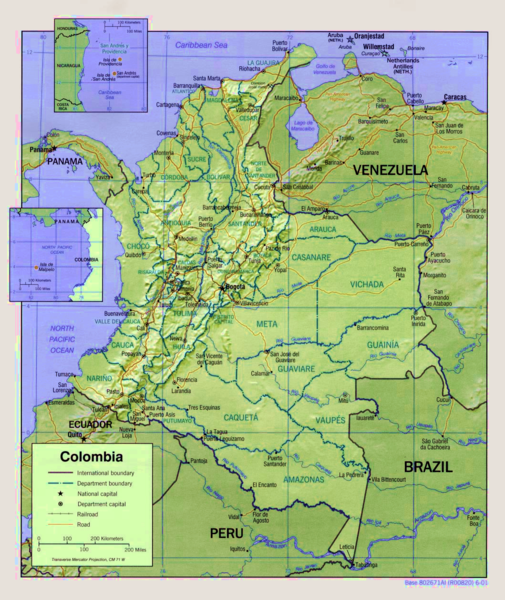
The Republic of Colombia is the 4th largest nation in South America birthed from colonialism and the name Christopher Columbus with two main warring factional parties with embarrassing fringe elements, Conservatives and Liberals. Mix in the profligate drug trade of highly lucrative cocaine and the mix is permanently combustible. Drug cartels, both Medellín and Cali, were world famous for their brutal kidnappings and torture.

The Andean foothills and the picturesque coast are where the majority of the population reside while the steamy tropical Amazon jungle portion is used to hide a multitude of sins and long held hostages.
Fuerzas Armadas Revolucionarias de Colombia or FARC holds a four star terrorist tag in the US and in official Colombia, but not with Hugo Chavez's Venezuela or a Castro's Cuba because of their Marxist-Lenin communist origins inspired by Bolivar. Common cause was attempted multiple time with the cartels by rebel members of FARC.

Today's FARC is below 10,000 guerrillas after a rampaging heyday controlling much of the rainforest and the production of cocaine. Bogotá citizens of import held another lucrative fundraising means, kidnapping for ransom. Except, when FARC does the kidnapping, it is for years or decade and the victim is forced to survive the most treacherous of environments while being chained like the neighborhood dog with nonstop beatings. FARC twin system of oppression forced juveniles, boys and girls, into servitude and hostages into submission. Hostages stumbling out of the territory into the civilization after years make for dramatic moments to crush the supposed invincibility of FARC. FARC-EP is up against a conservative president that is determined to cur off their supply lines and deploy the military to take back the country by driving the rebels deeper into ferocious foilage while decreasing their numbers by offering incentives for defections and assassinations. That lead to another miracle emerging from the depths of human depravity.

Oscar Tulio Lizcano, 63, escaped through the jungles, marching for three days with his FARC jailer before reaching an army post on Sunday where the guerrilla surrendered to troops.

His escape is the latest blow to the Revolutionary Armed Forces of
Colombia, or FARC, which has lost three top commanders this year as
President Alvaro Uribe's U.S.-backed military campaign drives rebels deeper into remote jungles.

"The loneliness was terrible. They were forbidden to talk to me," Lizcano, who once taught university classes, told Caracol radio. "I put sticks in the ground... and gave them names and taught them classes, two or three hours a day in classes, imagining I was in a classroom."

Earlier this year, FARC suffered more humiliation of the Colombian military rescuing hostages without a shot being fired by tricking them. American defense contractors held for five years were among those released alongside former presidential candidate Ingrid Betancourt on 2 July. This escape is a double whammy with the ex-FARC guard who aided congressman and college economics's lecturer Lizcano's escape after his 5 August, 2000 abduction, winning asylum to France with his paramour and a cash reward of just over $400,000 from the USA. France has been instrumental in seeking means to release hostages with the added incentive of Betancourt being a dual French citizen.

Lecturing stick students on World War I, Bolivarianism and Philosophy in an open air jungle amphitheater full of parasites, biting bugs and poisonous snakes was an innovative
way to pass the time and keep the mind working under terrible circumstances. Not allowed to speak to his baker's dozen of guards, even as they starved due to the disruption of their supply lines, the student sticks were his company for three hours a day. The occasional treat was a radio that played family messages on Sunday nights or the meal of heart of palm or sugar cane.

Meanwhile, Colombia is on an international charm offensive led by President Alvaro Uribe. The image is that Columbia is cleaning up its act - narco-terrorism and there should be every reason for the US Congress to approve the Colombian Free Trade Agreement according to conservatives. Strong on crime continues when Colombia seizes a record stash of ten tons of cocaine destined for Veracruz, Mexico, via Venezuela demonstrating a resurgent cartel system, when in walks one of the latest worst cases of human rights abuses in the rag-tag emaciated form of Oscar Tulio Lizcano. (Photo AFP/Getty)


More people are familiar with the depravity of Pablo Escobar. Ron Chepesiuk brings the Cali cartels modus operandi into stark relief as they used guile and cunning to build a chilling corporate structure that too k more than twenty years and a twisted human wreckage to unravel. The book that lays it all out in painful detail is Drug Lords: The Rise and Fall of the Cali Cartel.


Saturday, September 27, 2008

England Claims Giving Birth to Champagne

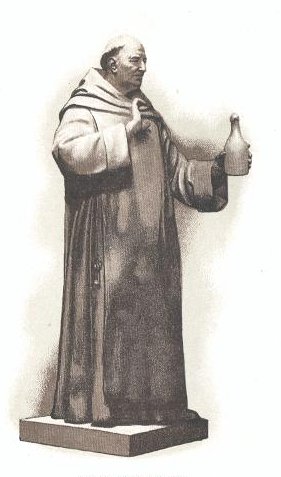
England & France have needed European marriage counseling since the Dark Ages. France famously touts its epicurean delights while thumbing their noses at the oxymoron of an Escoffier English chef. Bangers and mash or fish and chips versus haute cuisine croissants and flambéed Crêpes Suzette. The crux of the latest battle du jour is the birthplace of sparkling wine, champagne. Dom Pèrignon is effervescing in friarly indignation in his grave right now after being asked to come up with a way to make the wine bottles stop exploding in the abbey wine 'cellar'.

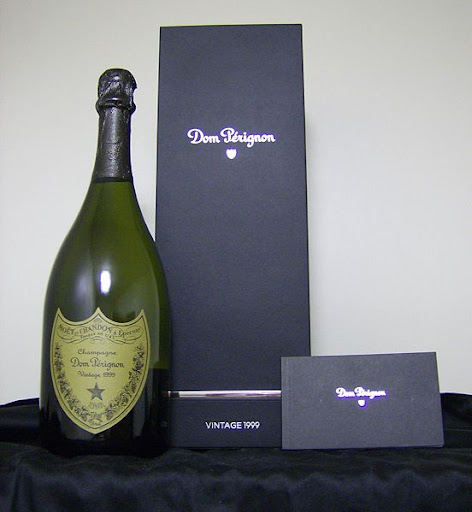
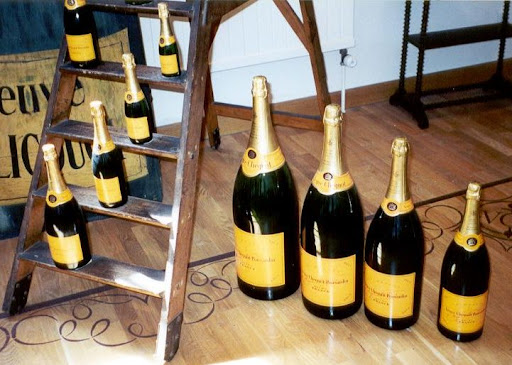
Champagne merits special stemware for events that warrant hors d'oeuvres as it is a regal drink of bubbly celebration or splashing the side of a newly launched cruiseliner. France has whole regions of the countryside named Champagne from the medieval period or large swaths of land dedicated to maintaining its pure-blood/wine grape lineage. The most famous names of Champagne began in the 18th century, Taittinger (1734), Moët et Chandon (1743) and Vueve Clicquot (1772). Out of a late summer rain cloud comes this cider-making English bloke from Somerset with a differing provenance of a 1632 Royal Society wine enthusiast who preceded Dom whose cuvée pedigree lasts. En garde.

Mr Crowden, from Chard in Somerset, researched Merret for his book on the history of cider called Ciderland.

He believes that the popularity of sparkling wines began when British cider-makers added sugar to acidic French white wine and then learnt how to control the resulting secondary fermentation. The sugar caused secondary fermentation in the bottle, which created sparkling wines.

Merrett also invented the thick green bottle strong enough to contain the pressure of secondary fermentation. French wine-makers had been plagued by the problem of unintended fermentation, which could cause whole cellars of their fragile bottles to explode. By learning to control it they were able to create sparkling wine by design rather than accident.

Heavens to murgatroy and exploding bottles and French minds everywhere. The plot thickens because the premise is based on a book release occurring with the week along with a presentation to today's English Royal Society citing the glass to contain the rowdy bubbly was also Merret's invention. This peer review could turn itself into another over the channel blood feud between the Saxons and the Normans. The French do not have a sense of humour about champagne - at all. There are laws and no, I am not kidding.
In 1941, the Comite Interprofessional du Vin de
Champagne (CIVC) was founded to protect the champagne market. Yep, right in the middle of WWII, champagne interests superseded Panzer divisions breaking into the country. In 1891, the Treaty of Madrid, made it clear that only sparkling wine produced in certain areas meeting specific standards could use the name champagne. World War I participants affirmed that ruling in the Treaty of Versailles. these words were legend in France and not usable elsewhere: méthode champenoise or champagne method. That's why this new theory is going to come under a cultural assault or a walk of roses from vintners and other interested parties the world over. Switzerland had a town named Champagne and they agreed to lose the name in 2004. I'd say get your popcorn, but that is so plebian to wash down with champagne from Champagne.

The new enfant terrible of champagne books, Ciderland is from the Somerset chap, James Crowden. For those seeking a tour de fource in the sparkling beverage's royal lineage need look no further than the well researched 4000 Champagnes from neutral Swedish expert author , Richard Juhlin.


Enjoy your French bubbly, oui?

Friday, September 12, 2008

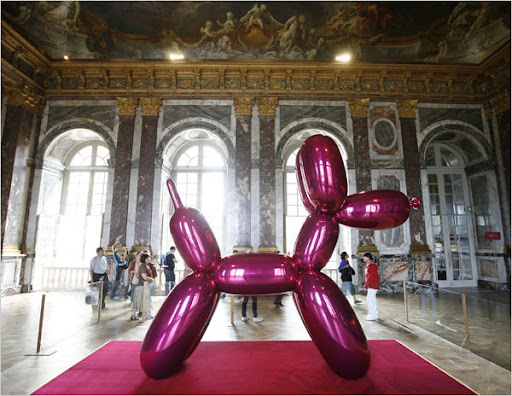
French Horrified by Pop Art at Versailles


Balloon Dog 1999-2000

(Photos by Ed Alcock of NYT)

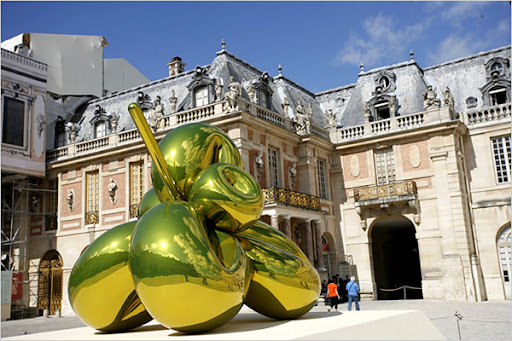
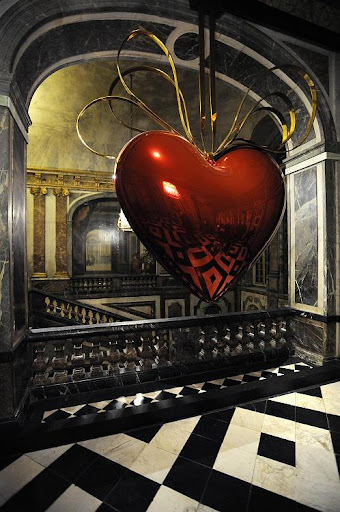
An invasion by an American pop art retrospective at the Palace of Versailles has the French clutching their pearls and hurling furious words of lament. I lose track of the various Louis' , but each in their own was left an architectural imprint. Since Louis XIII built the original Château at Versailles for his hunting excursions, it was not at all posh at the time of his early death when XIV was five years old. The Sun King, Louis XIV, cut a deal to build a city Versailles where the big real estate lots were free except for the need to build the exact house designed by his palace architect ensuring the neighborhood was a seventeenth century planned community. Great idea because he moved the entire kingdom apparatus to Versailles and needed it to look kingly royal surrounded by a great city. The French know city planning and landscaping. In The United States, Lafayette's work is on display in the capital's layout and its architecture thanks to George Washington. That's why new age art hanging amongst some of France's proudest treasures has the National Union of Writers of France both agape and aghast at the effrontery. France has the contemporary exhibit until 14 December.
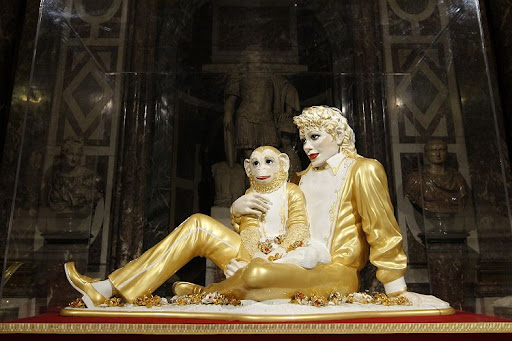
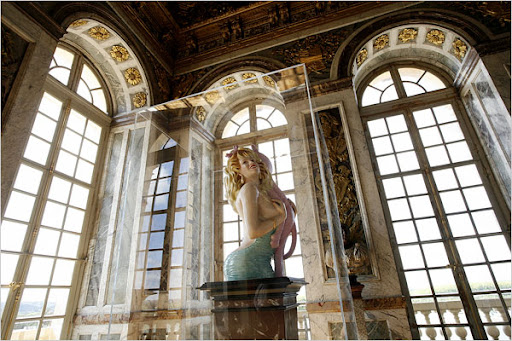
Versailles is also a World Heritage Site, one of under a thousand in the entire world that wait years to gain the prestigious cultural honor. Now its got 21st century pop art littered throughout its auspicious gilt-filled rooms and the multitude of mirrors reflect the horror. Louis no. 14 has a room with a portrait of him and one of his grandson which are considered masterpieces. Artist Jeff Koons, cheekily placed his self portrait in that room which frankly unless you have heard French curses, one may not appreciate how much that rankled. Not sure which a tourist would see first, but the various vacuum cleaners in a clear cubed tier, New Hoover Convertibles (1981-1987) in the Queen's (think Marie Antoinette) sitting room outside her chamber may have set off the furious imprecations as Koons described it as womb-like. The juxtapositions are part of the grand palace show. Michael Jackson and his monkey, Bubbles, (1998) are done in a rococo style with over the top golden bling and a metaphoric plaster white face for both encased in a clear plastic cube that just makes one's mouth form a perfect O. I guess that was the full intent until one enters the sunny room full of french doors and Louis XV signing a Peace treaty and partakes of the topless Paris Hilton-styled bombshell with an artfully placed flamingo pink boa, then your jaw just unhinges as one figures out what to look at first, world history or globe trotting hotties in a piece nicknamed Pink Panther (1988).
Koons' sculpted rabbits and dogs "don't belong at the palace of Versailles, they belong at Disneyland," said journalist and radio host Anne Brassie.
Arnaud-Aaron Upinsky, the president of a writers' union, agreed. "This exhibit is sacrilegious and insulting to the symbols of the Republic and its art," he said, wearing a velvet-and-gold-colored crown at the protest.
Koons said he has no intention of mocking the palace that Louis XIV transformed from a hunting lodge into a symbol of royal power in the 17th century.
"I'm so grateful for the opportunity to show in Versailles. I have complete respect for Versailles and I have complete respect for each individual that's coming to Versailles," Koons told reporters.
Pink Panther(1988) & Split Rocker (2000)

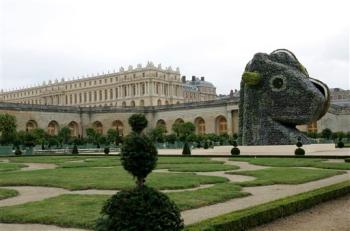
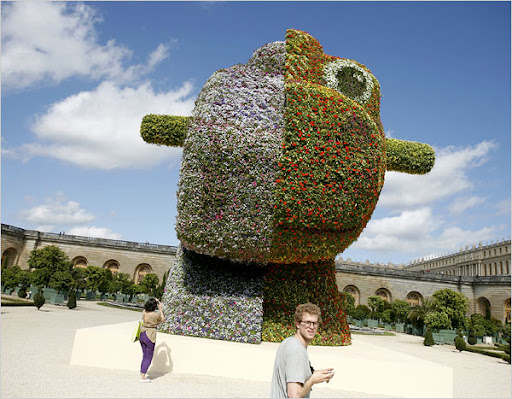
There are 17 pieces of pop art to see placed throughout the sumptuous palais and on the manicured grounds with its own private lake. Tens of thousands of flower pots gave their all to make up the behemoth entitled Split Rocker. The lobster hanging by a red string amidst some world class art is not to be missed. This is not the first time it's been done by Koons. Ballon Dog also made a splash at the Palazzo in Venice's Grand Canal. Seems continental Europe can't get enough of the art of auspicious staging. Seven million people a year visit Versailles in its regular state, this will pull in a few more Looky Lou's for sure.

Versailles, in its natural state of elegantly named Salons and Grand Apartments fit for royal politics can be appreciated in person or for a good deal less. Available is the October release of Versailles: A Biography of A Place at 20.00 or the must have coffee table art book from Jean-Marie Perouse De Montclos for $60 in simply titled, Versailles.

Wednesday, June 25, 2008

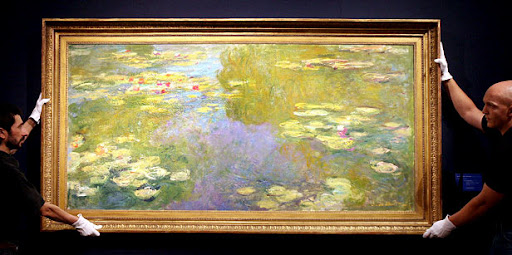
Monet's Water Lily Art Worth Millions at Auction

(Photo EPA)
Painting a water lily is the province of one man. Beautiful lily renditions are in top galleries and fine museums all over the globe. He painted but four for this series. Now, for the second time in less than two months, at double the first piece's price, a rich telephone bidder takes home an original rarely seen impressionist painting, "Le Bassin aux Nymphéas" (1919), by impresario Claude Monet. How much time does one have to sit and gaze in front of the painting then when one divides that into the sale price of £41 million or in US dollars 80.5 million? What is the equivalent of spending thousands every time the owner just glances over the gorgeous work of art. It sort of stings that the 1873 artwork sold for only £2omillion or $41.4 million at Christie's in London. London auctioneers are ecstatic as art pieces worth over a billion dollars goes on sale over the next fortnight. The Monet sale bodes well and the decline of the dollar just makes it even more expensive for American buyers.

Before the auction, Olivier Camu, Christie's director and head of Impressionist and Modern Art, described it as "the greatest of Claude Monet's water-lily pictures to be offered at auction in Europe".

It was the star lot of Christie's Impressionist and Modern Art Evening Sale that also featured works by Picasso, Matisse, Kandinsky, Renoir, Degas and Henry Moore.

The sale was initially expected to fetch £90 million but - as has become familiar in auction rooms this summer - that was set to be easily exceeded.

Art has the bulging purses of the super rich wide open. Many pieces, including a Henry Moore sculpture sold in London, are fetching prices belying the world's current economic strife. The water lily painting sold has the platinum attributes of having been one of four signed and dated by the artist in 1919. Monet painted up to his death in 1926. A beautiful pastel work , Danseuese a la Barre from the mighty Edgar Degas was not a shabby purchase at 13.5 million pounds or $28 million US.

Helena Newman, the vice-chairman of Sotheby’s Impressionist and Modern Art department, said yesterday: “People’s choices are now being driven by image rather than the artist’s name. We’ve never seen a period where the bidding showed such a range of tastes.

“They want to look at their pieces, enjoy them and show them off. Colour and strong bold compositions are grabbing them and these are the sort of collectors for whom the estimate price is just a starting point.”

Bold, early 20th-century paintings with “wallpower” have been smashing records in New York and London. They include Weidende Pferde III by Marc, which sold for £12.3 million in London, £4 million above the estimate; Munch’s Girl on a Bridge, which sold for $30.8 million (£15.6 million); and Lyonel Feininger’s Jesuits III, which raised $23.2 million. There have also been new records for Monet and Rodin in the same period.
(Art: Raoul Dufy, Le Havre)

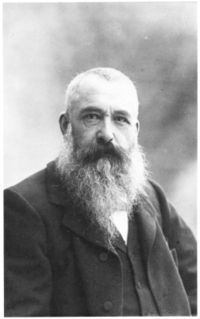
Little did Claude Monet envision these sums of lucre for the work he painted while at home in the French countryside of Giverny. In 1966, his heirs made the French Academy of Fine Arts the recipients of Monet's home where the famed water lily pond took French impressionism soaring. It is now part of the renowned Institut de France. Since 1980 it has been open to the public and is well worth the visit. Monet, friend of Renoir and Manet, has Japanese woodcuts on display that demonstrate a versatility and his dismissal or disdain of conventional wisdom of art at the time. (Photo Monet from 1899)


Derek Fell brings another delightful and detailed view of what inspired Monet. His book, The Magic of Monet's Garden: His Planting and Color Harmonies demonstrate how the abundant water lily pond and other areas of his home and its landscape were such inspirations.

Wednesday, April 9, 2008

The Race to Find "The God Particle"

A question absorbing humans since inception is, what is the meaning of life, really? Science is not shying away from its version of that mega philosophy question by seeking truth in the subatomic world for the Higgs boson or God Particle. So far, a quarter century of brain power, and $2-6 billion big ones is the cost on building the LHC or Large Hadron Collider. One of its experiments will be to smash atoms into each other at near the speed of light to itemize their photon gut contents as they break apart in massive explosions. In the collider, the expectation - that's scientific speak for Hope, is scientists will find the Last Mohican boson existing in theoretical suspicion outside the Standard Model which may provide the key or original spark to give life.

Working from Higgs' theory, scientists postulate that initially weightless particles move through a ubiquitous quantum field, known as a Higgs field, like a pearl necklace through a jar of honey. Some particles, such as photons — weightless carriers of light — can cut through the sticky Higgs field without picking up mass. Others get bogged down and become heavy; that is the process that creates tangible matter. "The Higgs gives everything in the universe its mass. Some might say that makes the universe messy. But there's still a beauty to this interaction," says David Francis, a physicist on the ATLAS experiment. "Look at what's around us," he says, pointing at CERN's grand geological amphitheater of the Jura and the Alps. "None of that is possible without the Higgs."

For one particle physicist, he feels the crush of the one way space time continuum, having worked for 40 years on his pet particle theory that the God Particle exists. Peter Higgs, another great Scottish scientist, is now a spry 78, with a firm belief, next year is the year that will yield the result proving his boson theory. The Elegant Universe is the name of a wonderful book as well as the way physicists want their theories to look, but some times its just primordial gumbo that makes the Grand Unified Theory seem within grasp.

The new Geneva collider will re-create the rapidly changing conditions in the universe a split second after the Big Bang. It will be the closest that scientists have come to the event that they theorize was the beginning of the universe. They hope the new equipment will enable them to study particles and forces yet unobserved.

Nobel laureate Leon Lederman has dubbed the theoretical boson "the God particle" because its discovery could unify understanding of particle physics and help humans "know the mind of God."

Higgs said initial reaction to his ideas in the early 1960s was skeptical.

"My colleagues thought I was a bit of an idiot," he said, noting that his initial paper explaining how his theory worked was rejected by an editor at CERN.
Science fiction readers are not unfamiliar with the concept, but the rest of the world would need some serious adjustments if the God Particle is a QED. Right now, until the LHC goes online this summer, the Higgs theory is a concept requiring further proofs.

Technology and ever powerful supercolliders are competing on two continents to be the Higgs Boson finder of record - CERN, formally known as the European Organization for Nuclear Research, and Fermilab, cute and short for Fermi National Accelerator Laboratory. CERN is coming later to the search after spending a fortune to build the LHC deep underground in a 17 mile circular loop at a small town named Crozet at the border of France & Switzerland. Fermilab is under US Department of Energy control outside Chicago, in Batavia, where Higgs believes they already found "it" using Tevatron, but are zealously keeping it under wraps. I love science intrigues. Introverts with IQ's over 140 battling it out to be the most persistent demented geniuses with something to prove or disprove, known in the scientific world as peer review.

Dick Teresi and Leon Lederman decided on humor and a light touch to take the reader on the journey to the the complexities of the singular particle that contains all. Enjoying a book about physics is supposedly a hard thing to do, except the examples of great books from science luminaries and writers keeps destroying that premise. Have a great time getting physics literate by reading The God Particle: If the Universe is the Answer, What is The Question?